
Prop Firm Consistency Rules 2026: What They Are and How EAs Handle Them Automatically

Table of Contents
What the Consistency Rule Actually Means
The consistency rule is a requirement that no single trading day accounts for a disproportionately large share of an account's total evaluation profit. The specific thresholds vary by firm, but the underlying logic is the same across all implementations: prop firms want to see trading performance that is stable and repeatable rather than a single exceptional day surrounded by flat or marginally profitable activity.
From the prop firm's perspective, this rule is a fraud and risk management tool. A trader who makes 9% of their target in a single day through highly leveraged positions and then trades flat for the rest of the evaluation is demonstrating luck or risk behavior that the firm does not want to fund at scale. The consistency rule filters for genuine systematic performance across multiple market sessions. For a legitimate prop firm passing ea running at consistent position sizes, the rule should not be triggerable in theory - the challenge is that in practice, market conditions vary and an EA running its normal risk parameters can produce an outsized day simply because it caught 8 successful trades during an unusually trending session.
Understanding the rule's intent helps you understand how to configure around it. You are not trying to hide performance - you are ensuring your position sizing prevents any single day from becoming so profitable that it skews the distribution of results beyond the rule's threshold.

How Each Firm Calculates Consistency
The specific calculation method matters enormously for how you configure your EA. Firms use 2 main approaches, and they produce very different practical constraints on your trading.
Percentage-of-total-profit method (FTMO): FTMO's consistency rule states that no single trading day's profit should exceed a certain percentage of total account profits at the time of the payout request. The specific threshold is not published as a hard number in their public documentation - FTMO evaluates consistency as part of their manual review process and uses trader judgment rather than an automated cutoff. In practice, community data suggests that a single day representing more than 40 to 50% of total evaluation profit tends to trigger a review. A day representing 60%+ of total profits almost always leads to a payout delay or request for additional trading history. For a forex trading ea, this means if you hit your profit target quickly and one day accounts for the majority of that target, FTMO may ask for more trading history before releasing the payout.
Fixed maximum daily profit method (some firms): Some firms cap the maximum daily profit as a percentage of account balance. A firm with a 2% daily profit cap means no single day can contribute more than 2% of the account balance to profits - regardless of how you achieved it. For a $100K account, the cap is $2,000 per day. This is a harder rule than FTMO's proportional approach because it creates a strict ceiling regardless of total profits. An EA needs to have position sizing that makes exceeding this ceiling essentially impossible through normal operation.
Minimum trading days method: Several firms combine consistency with a minimum trading day requirement - you must have at least a certain number of active trading days to reach the funded stage. This is separate from but related to the consistency rule. The interaction matters: if you hit your profit target in 4 days but the firm requires 5 minimum trading days, you must continue trading for 1 more day even though you have already achieved the financial target. Configure your EA to continue operating in this scenario rather than stopping at the profit target threshold.
Why EAs Commonly Trigger Consistency Violations
Automated trading strategies are more susceptible to consistency rule violations than manual trading for a specific structural reason: EAs execute every qualifying signal without hesitation, while human traders self-regulate based on how a trading day feels. When market conditions align perfectly with an EA's entry logic - a strongly trending session where multiple signals fire back-to-back and all resolve in the target direction - the EA will take every trade and generate an outsized profit day. A human trader in the same situation might take the first 3 trades and then feel cautious about overtrading, naturally limiting the day's contribution to total profits.
The other common trigger is running an EA at a risk-per-trade percentage that is too high relative to the evaluation's profit target. If your profit target is 10% and you run the EA at 2% risk per trade with aggressive take profits, a single 5-trade winning session could generate 8 to 10% of the target in one day. Even if the EA's normal daily results are much smaller, this single day would represent the majority of the evaluation's total profit, triggering a consistency review regardless of how steady the remaining trading looks.
How a Configured EA Prevents Violations
A well-built prop firm EA includes specific logic to prevent consistency violations without requiring manual intervention. There are 3 mechanisms that handle this cleanly when implemented correctly.
Daily profit cap logic: The EA tracks cumulative daily profit in real time and stops opening new positions once a configurable daily profit ceiling is reached. For example, if you set the daily profit cap at 2% of account balance, the EA will not enter any new trades once that day's profit reaches $2,000 on a $100K account - regardless of how many signals it would otherwise execute. This is the simplest and most effective consistency protection mechanism. The cap does not close existing open trades; it simply prevents new entries until the next trading day begins.
Risk reduction scaling: More sophisticated implementations reduce position sizing as daily profit grows rather than cutting off new entries entirely. When daily profit reaches 1% of balance, risk per trade might drop to 50% of its normal level. At 1.5%, it drops to 25%. At 2%, trading stops entirely. This produces a more natural-looking daily profit distribution than a hard cutoff and is less likely to produce an unusual gap in the trading log where positions simply stopped appearing mid-session.
Time distribution filters: Some EA configurations spread entry opportunities more evenly across sessions by limiting the number of trades per time window, which reduces the probability of all entries clustering into a single high-profit session. This is a secondary mechanism rather than a primary consistency control - it improves the overall distribution of results but should not be the only protection in place.
Position Sizing as the Primary Solution
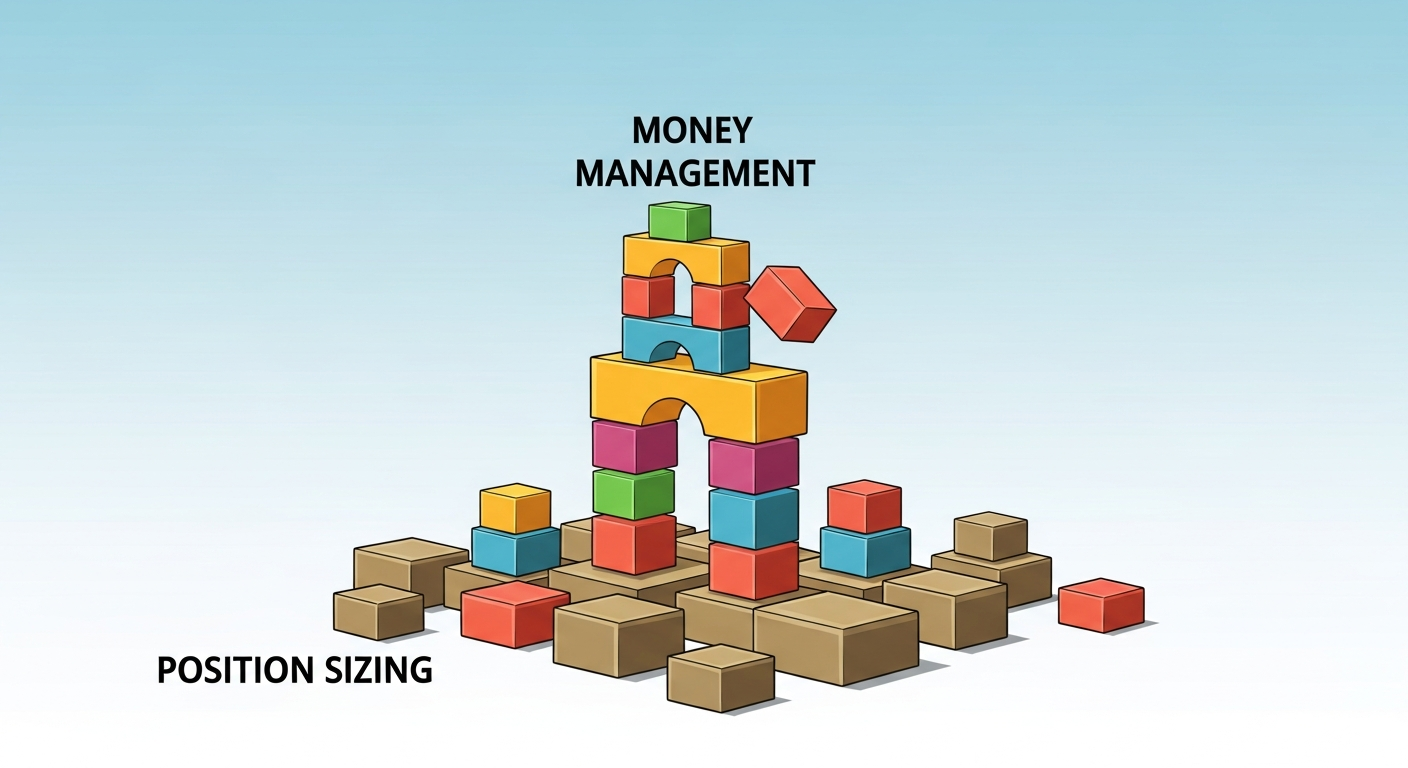
The most fundamental protection against consistency violations is setting risk-per-trade at a level that makes a single outlier day structurally unlikely to dominate total profits. The math here is straightforward and worth doing before starting any evaluation.
If your profit target is 10% and you want no single day to represent more than 35% of total evaluation profits (a conservative threshold that comfortably clears FTMO's informal consistency expectation), the maximum single-day profit you are targeting is 3.5% of account balance. If your EA typically executes 3 to 5 trades per day on its best sessions and has an average win rate of 60%, the maximum risk per trade that makes a 3.5% single-day profit essentially impossible through normal operation is approximately 0.5 to 0.8% per trade.
Running at 0.5 to 0.8% risk per trade on a 10% target evaluation means reaching the target requires roughly 15 to 25 profitable trading days - a realistic timeframe for a 30-day evaluation window. The trade-off is that your evaluation takes longer to complete, but it completes in a way that requires no intervention and is almost certain to pass a consistency review without question. This is the configuration that experienced multi-account prop firm passing ea traders use for exactly this reason.
Firm-by-Firm Consistency Rule Summary
FTMO: Informal consistency review at payout stage. No published hard threshold, but community data consistently points to single-day profit below 40% of total evaluation profit as safe. Hard consistency violations are rare with conservative position sizing. Recommend running a daily profit cap at 2.5% of account balance as a precaution.
E8 Funding: No formal consistency rule in their published evaluation terms as of June 2026. E8's rules focus on drawdown limits and profit targets without a proportional daily profit restriction. This is one of E8's most EA-friendly features - you can have a strong single day without triggering a compliance review. Still recommended to run conservative position sizing, but the consistency rule is not the reason to do so at E8.
Alpha Capital: Alpha Capital applies a consistency check as part of their funded account review but does not publish specific thresholds. Their support has confirmed in community channels that consistency is evaluated case by case. Running with standard conservative position sizing (0.5 to 1% risk per trade) effectively eliminates any risk of triggering a review at Alpha Capital.
FundedNext: FundedNext's "Stellar" track includes a stated consistency rule: the best single trading day's profit cannot exceed 50% of total profits. This is the clearest published threshold among major firms. For a 10% target evaluation, this means no single day should exceed 5% of account balance in profit. At 0.8% risk per trade, this threshold is essentially unreachable through normal operation.
The Funded Trader: Their Standard track (updated to static drawdown in May 2026) does not include a consistency rule. Their Royal track includes one, structured similarly to FundedNext's 50% threshold. If you are using Standard track, consistency is not a concern. If you are using Royal track, treat it like FundedNext and apply a daily profit cap in your EA configuration.

What to Verify Before Starting an Evaluation
Before running your EA on any new evaluation, go through this checklist to confirm your consistency protection is correctly configured.
First, look up the specific consistency rule for the firm and account type you are using. Do not assume the rule is the same across a firm's different challenge tracks - it frequently is not. Check the current version of the evaluation agreement, not a third-party summary that may be outdated.
Second, confirm that your EA has a daily profit cap feature and that it is enabled. Check the configuration value - many EAs ship with this set to 0 (disabled) by default. Set it to a conservative value like 2 to 2.5% of account balance for firms with consistency reviews, or leave it slightly higher (3 to 3.5%) for firms like E8 where consistency is not formally enforced.
Third, back-calculate the maximum single-day profit your EA could realistically achieve based on its risk settings and typical daily trade frequency. If the realistic maximum single-day profit approaches or exceeds 40% of your profit target, reduce position sizing or lower the daily cap before starting. Running this calculation on historical backtest data for your specific EA gives you a much more accurate picture than generic estimates.
Fourth, after your first week of a live evaluation, check the daily profit distribution in your trading log. If any single day already represents more than 25% of your accumulated profits after 1 week, consider reducing risk slightly for the remainder of the evaluation to ensure the final distribution stays well within acceptable proportions.
Consistency Rules Handled Automatically
Prop Firm EA includes a built-in daily profit cap that activates automatically based on the evaluation type you select at setup. FTMO, FundedNext, and all other firm configurations come with pre-set consistency protection that prevents any single day from dominating your evaluation's profit distribution. No manual intervention required.
Visit PropFirmEA.comFor related reading on EA configuration before evaluations, see our complete EA settings optimization guide and our breakdown of drawdown rules and how they affect EA configuration.
Related Articles
Prop Firm Profit Split Comparison 2026: Which Firm Pays EA Traders the Most? [Updated April 2026]
An 80% profit split sounds generous until you compare it against a 90% competitor. But the headline number is only one dimension of the income comparison. Here is the complete payout analysis EA traders actually need.
Prop Firm Drawdown Rules Explained: Trailing vs Static and What They Mean for Your EA
Trailing drawdown and static drawdown are not the same thing, and confusing them is one of the most expensive mistakes EA traders make. This guide explains both types clearly and shows you exactly how to configure your EA for each.
The Best Prop Firm Account Size for EA Trading: $10K, $50K, $100K, or $200K?
Account size is one of the most consequential decisions EA traders make, but most pick based on budget alone. Here is the strategic framework for choosing the account size that maximizes your actual long-term income potential.