

Alex M
Professional Forex Trader & Prop Firm Analyst
Alex M is a full-time forex trader who reached the #1 spot on the FTMO leaderboard with $257,686 in verified profit on a $400K max allocation account. She manages over $1M in combined funded capital across FTMO, Alpha Capital, FundedNext, and The5ers, built entirely through prop firm evaluations over the past 8 years. Beyond her own trading, Alex runs an active community where she shares evaluation strategies, risk management frameworks, and what it actually takes to stay funded long-term. Everything she writes on this site comes from personal experience, not theory.
Funding Pips Mean Reversion EA Review
Can a Mean Reversion EA Pass an Funding Pips Evaluation?
The short answer depends on exposure control, current firm terms, and whether the strategy can survive its weakest market conditions. A mean reversion EA seeks a return toward a tested reference after an extension. The system should stand aside when directional persistence makes fading unsafe.
This review separates three questions. Can the strategy stay inside the published loss limits? Can the execution pattern avoid avoidable operational flags? Can the total cost reach breakeven before the first payout?

Before you compare settings, read the prop firm ea homepage review for the wider product context. Then use this page for the specific Funding Pips and Mean Reversion EA combination.
Why Mean Reversion EA Risk Matters on Funding Pips
A mean reversion EA seeks a return toward a tested reference after an extension. The system should stand aside when directional persistence makes fading unsafe.
Grid spacing, multiplier size, maximum layers, and the emergency stop define the real risk. The label on the Expert Advisor matters less than the worst-case open exposure when several positions move against the basket.
- Grid spacing: Wider spacing can reduce trade frequency but may delay recovery.
- Multiplier: A larger multiplier increases the next entry and can consume the loss buffer quickly.
- Layer cap: A fixed maximum is safer than unlimited averaging.
- Equity stop: A hard stop must act before the firm limit, not after it.
Use the current video alongside the written rule and risk analysis.
Funding Pips Drawdown Limits and Trading Rules
This review models the stated account loss boundaries. Spread, slippage, open equity, correlated exposure, and the complete stop outcome must remain inside the budget.
Rules to Confirm Before You Start
- Daily loss: Model the 5% limit against equity, floating positions, commissions, and spread changes.
- Maximum loss: Keep the basket and every recovery layer below the 10% account-level ceiling.
- News: Confirm current event, holding, automation, and execution rules before deployment.
- Server time: Use the firm's stated reset time, not your local clock, when calculating daily loss.
- Weekend and overnight positions: Confirm the current terms for the exact account type before leaving strategy exposure open.
Stop Burning Money on Failed Manual Attempts
Keep the existing review workflow, then compare your evaluation fee, EA cost, and available drawdown before taking the next challenge.
Funding Pips Mean Reversion EA Review
Funding Pips may permit automated trading under its current terms, but permission does not protect a strategy from market risk. The right question is whether this EA type has enough unused drawdown capacity when the basket reaches its maximum size.
For this combination, the strongest setup is conservative. Use a smaller multiplier, cap the number of layers, stop before the published limit, and test the same broker feed and platform conditions that the evaluation will use.
Key review takeaways
Firm: Funding Pips
EA type: Mean Reversion EA
Primary concern: Shared entries, repeated timing, copied settings, and synchronized exits can create a recognizable execution profile.
What Makes This Combination Different
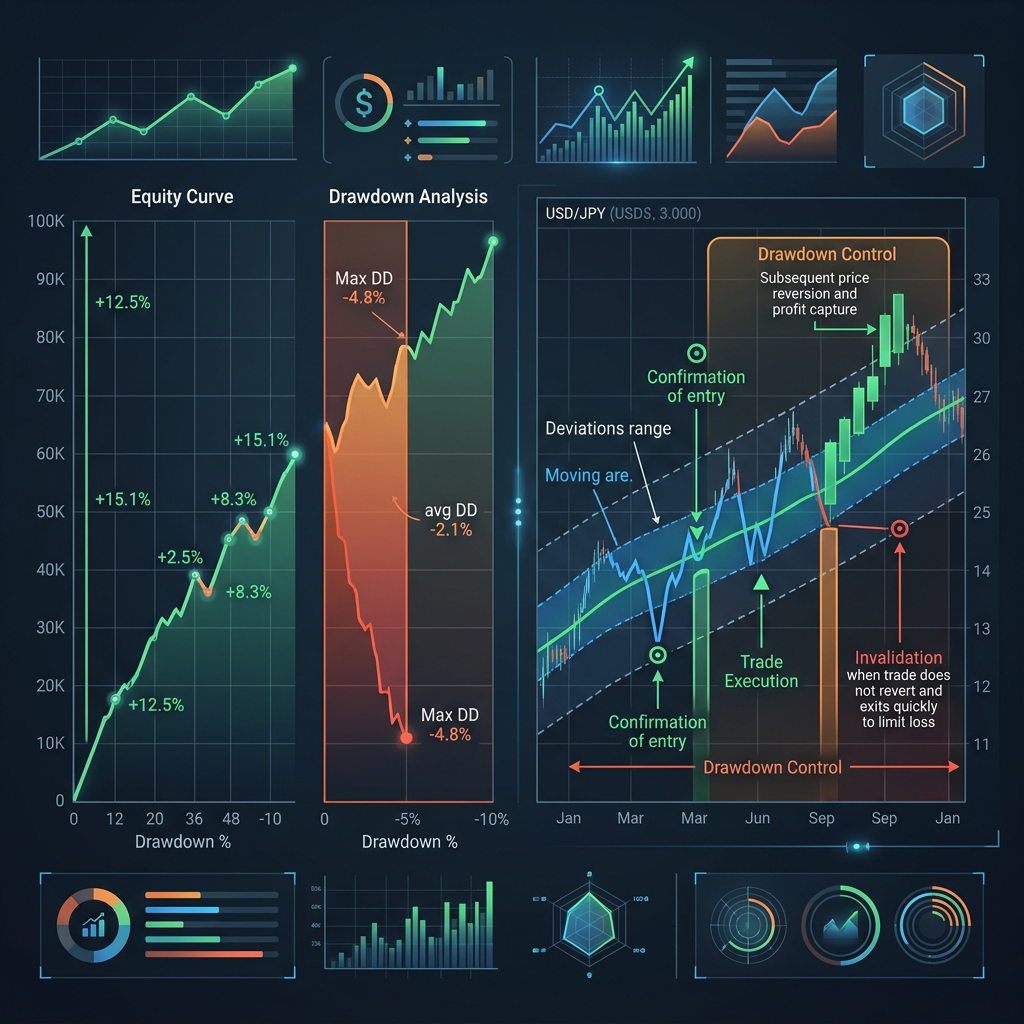
The system measures deviation, confirms rejection, sets a stop, filters trends, and limits repeated entries in one direction.

That makes account-level controls more important than a high backtest recovery rate. A strategy can recover many short sequences and still fail one evaluation during a persistent trend, gap, or liquidity shock.

How This EA Compares With Manual Trading
| Feature | Prop Firm EA | Alternatives |
|---|---|---|
| Rule-aware position sizing | Manual | |
| Grid exposure cap | Required | Often undefined |
| News-event filter | Depends on trader | |
| Daily drawdown monitoring | Manual checks | |
| Identical batch risk | Must be controlled | Varies |
| Initial modeled cost | $1,094 | $497 |
Results, Testing and Verification
Do not treat a profitable screenshot as proof that an automated strategy respects an evaluation. Verify the complete sequence, including the largest exposure, maximum floating loss, spread conditions, and the weakest market periods for this EA type.
Current Prop Firm EA User Reviews
"I failed FTMO 3 times trading manually, losing over $1,800 in fees. Prop Firm EA passed it on the first try. Now I'm trading a $100K account with the EA handling everything."
"I run 3 funded accounts simultaneously across FTMO, FunderPro, and E8. Prop Firm EA manages all 3 from one VPS. It passed all 3 challenges within 2 weeks of each other in late February. The scalability is something no manual trader could ever replicate."
"As someone who works full-time, I never had the hours to sit and trade during London or New York sessions. Prop Firm EA runs 24/7 on my VPS and passed 2 challenges back to back in February 2026. The set-and-forget automation is a game changer for anyone with a busy schedule."
"I was skeptical about EAs after getting burned by 2 scammy robots in 2024. What convinced me with Prop Firm EA was the Discord, with hundreds of real traders posting real results every day. Passed my $200K FTMO challenge in March 2026. The risk management alone is worth the price."
"I tried to pass 3 different prop firms manually over 8 months and failed every single one. April 2026 I finally tried Prop Firm EA. It passed Alpha Capital Phase 1 in 6 days and FundedNext Phase 1 in 8 days. I now have 2 funded accounts generating income I never managed to get on my own."
"Tried four EAs. This was the first one I could leave running without babysitting it. Passed my FTMO challenge in May. Drawdown stayed under 3.1%."
"Three accounts. One VPS. Two payouts in June. That was enough for me."
"I watched it closely for the first few days because I expected something to go wrong. Nothing did. The $100K FTMO challenge took nine trading days, and the drawdown was 2.4%. After that, I stopped checking every trade."
New Account Testing Checklist
- Run the EA on a demo account with the same account size and symbol list.
- Record maximum floating drawdown, not just closed-trade drawdown.
- Test spread widening around the news windows named in the current terms.
- Compare trade timestamps across accounts to identify identical batching.
- Confirm the VPS, broker-server time, and terminal reconnect behavior.
Join the 94% of Traders Who Pass
Keep the existing CTA position, but check the firm rules and the strategy's worst-case exposure before purchasing an evaluation.
How a Mean Reversion EA Works
A mean reversion EA seeks a return toward a tested reference after an extension. The system should stand aside when directional persistence makes fading unsafe.
1. Define Fair Value
Use a reference supported by testing across the intended instruments.
2. Require Extension
Wait for meaningful deviation instead of fading every small move.
3. Confirm the Return
Require stabilization or rejection before entering.
4. Set the Stop
Exit when price disproves the value thesis.
5. Limit Portfolio Risk
Group related symbols and cap total exposure.
Detection Risk and Breakeven Math
The detection assessment for this combination is Medium. Shared entries, repeated timing, copied settings, and synchronized exits can create a recognizable execution profile.

Modeled Cost
- Challenge fee: $497
- EA license: $597
- Total initial outlay: $1,094
- Modeled first payout after a 80% share: $6,400
- Initial cost recovered by approximately 17% of that modeled payout
The formula is simple: challenge cost plus EA license cost equals the initial outlay. Divide that outlay by the expected net first payout to estimate the breakeven share. Taxes, payment fees, currency conversion, refunds, and payout timing can change the real result.
The Honest Risks
- Persistent trends can defeat the mean.
- Averaging can compound losses.
- Events can create a new fair-value area.
- Related pairs can fail together.
End the Cycle of Expensive Manual Failures
Use the cost model, rule checks, and detection assessment before deciding whether this Funding Pips Mean Reversion EA combination belongs in your evaluation plan.
Final Verdict: Funding Pips Mean Reversion EA
A Funding Pips mean reversion EA must know when not to fade price. The invalidation stop protects the account when the regime changes.
Funding Pips Mean Reversion EA Verdict
Daily loss model: 5%
Maximum loss model: 10%
Detection and ban risk: Medium
Modeled initial outlay: $1,094
Modeled first payout: $6,400 net
Use this combination only if: the reference is tested, extension and confirmation are required, trends are filtered, and portfolio risk is capped.
Common Questions About Funding Pips Mean Reversion EA
Can you use a Mean Reversion EA with Funding Pips?
Automated trading may be permitted when it follows the current Funding Pips terms, but permission does not make every strategy safe. Verify the exact program before enabling the EA.
What drawdown limits does this Funding Pips review use?
This review models a 5% daily loss limit and a 10% maximum loss rule. Confirm the current values and calculation method for your account type before buying an evaluation.
What is the main risk of a Mean Reversion EA?
The system measures deviation, confirms rejection, sets a stop, filters trends, and limits repeated entries in one direction.
What is the detection risk for this EA type?
This review rates the risk Medium. Shared entries, repeated timing, copied settings, and synchronized exits can create a recognizable execution profile. The rating is an assessment, not a guarantee of how a firm will classify an account.
When does this Funding Pips EA plan break even?
Using a $497 challenge fee and a $597 EA license, the modeled initial outlay is $1,094. Against a $8,000 gross first payout with a 80% share, the modeled net payout is $6,400, before taxes and payment conversion costs.
Continue Learning: Expert Forex EA Guides
Compare more prop firm rules, automated trading strategies, drawdown controls, and payout planning.
Explore the Top 10 research library
Compare EAs, grid systems, gold strategies, scalpers, and news filters.
Read the prop firm EA guides
Review firm rules, VPS setup, drawdown controls, and automation.
How to Protect a Prop Firm EA During Low-Liquidity Sessions in 2026
Liquidity changes across the 24-hour forex market. This guide explains how global session overlaps, holidays, rollover, spreads, and slippage affect an EA running a prop firm evaluation.
Read ArticleBest Prop Firm Challenges for EA Traders in 2026: Updated May Rankings
Not all prop firm challenges are created equal for automated trading. We rank the top 6 evaluations by EA compatibility, rule strictness, fee value, and real-world pass rates - updated with May 2026 changes.
Read ArticleProp Firm Payouts in Your Local Currency: A Global Trader's Guide for 2026
Your dashboard balance is not the same as the amount that reaches your bank account. This global guide covers payout methods, currency conversion, fees, records, and planning for traders in every region.
Read ArticleCan You Actually Make a Living from Prop Firm Funded Accounts? An Honest Income Analysis
The prop firm income dream is real for some traders and a fantasy for others. Here is an honest breakdown of what the numbers look like at different scale levels and what role EAs play in making it genuinely sustainable.
Read ArticleProp Firm Drawdown Rules Explained: Trailing vs Static and What They Mean for Your EA
Trailing drawdown and static drawdown are not the same thing, and confusing them is one of the most expensive mistakes EA traders make. This guide explains both types clearly and shows you exactly how to configure your EA for each.
Read ArticleProp Firm Scaling Plans Explained: How EA Traders Grow from $25K to $400K in 2026
Scaling plans let you grow a $25,000 funded account to $400,000 using the firm's capital, not yours. This guide breaks down how each major firm's scaling works and how EA traders are hitting triggers faster than manual traders ever could.
Read ArticleProp Firm Profit Split Comparison 2026: Which Firm Pays EA Traders the Most? [Updated April 2026]
An 80% profit split sounds generous until you compare it against a 90% competitor. But the headline number is only one dimension of the income comparison. Here is the complete payout analysis EA traders actually need.
Read ArticleProp Firm EA Lot Sizing Guide 2026: How to Set the Right Risk Per Trade
Getting lot sizing wrong does not just hurt your performance - it ends your evaluation. This complete guide walks through the exact calculations for setting EA lot sizes across every major prop firm and account size.
Read ArticleWhy Your EA's Backtesting Numbers Look Nothing Like Live Trading (And How to Fix It)
Backtesting is not lying to you. It is showing you what would have happened under conditions that do not perfectly replicate live trading. Understanding the gap is the key to choosing an EA that actually delivers.
Read ArticleHow Prop Firm EAs Handle High-Impact News Events Without Triggering Rule Violations
NFP releases, Fed decisions, and CPI reports can make or break a prop firm evaluation in minutes. Here is exactly how well-designed EAs detect and manage these events - and what happens when they handle it wrong.
Read ArticleProp Firm Consistency Rules 2026: What They Are and How EAs Handle Them Automatically
Consistency rules catch funded traders by surprise more often than almost any other rule. This guide explains exactly how they work at each major firm and how a well-configured EA prevents violations without you needing to intervene.
Read ArticleThe Best Prop Firm Account Size for EA Trading: $10K, $50K, $100K, or $200K?
Account size is one of the most consequential decisions EA traders make, but most pick based on budget alone. Here is the strategic framework for choosing the account size that maximizes your actual long-term income potential.
Read ArticleHow to Set Up a Prop Firm EA From Scratch: Complete Beginner's Installation Guide
Setting up your first prop firm EA does not have to be complicated. This step-by-step guide covers everything from purchase to first live trade, including the common mistakes that cost beginners their evaluation fees.
Read ArticleHow to Run Multiple Prop Firm EAs on One VPS in 2026: Complete Multi-Account Setup Guide
Running 3 funded accounts on one VPS instead of 3 separate servers cuts your infrastructure costs by two-thirds. Here is exactly how to set it up correctly without accounts interfering with each other.
Read ArticleMetaTrader 4 vs MetaTrader 5 for Prop Firm EAs: The Complete Platform Guide 2026
MT4 or MT5? It is one of the most common questions among EA traders entering prop firm challenges. The answer depends on your specific algorithm, your target prop firm, and the direction the industry is heading. Here is everything you need to know.
Read ArticleHow to Withdraw from a Prop Firm Funded Account: The Complete 2026 Payment Guide
Getting funded is one thing. Getting paid is another. This guide covers every withdrawal method, payout schedule, and potential snag across the major prop firms so your profits actually reach your bank account.
Read ArticleFTMO vs The Funded Trader vs E8 Funding: Which Prop Firm Is Easiest to Pass with an EA?
Not all prop firms are equal when it comes to automated EA trading. We compare FTMO, The Funded Trader, and E8 Funding across every rule that matters so you know exactly where to start.
Read ArticleProp Firm EA vs Manual Trading: A 90-Day Head-to-Head Performance Comparison
Identical account sizes. Identical prop firms. One using a prop firm EA, one trading manually. We ran the comparison for 90 days. Here is what the data actually shows.
Read ArticleFTMO Challenge Rules 2026: The Complete EA Trader's Compliance Guide
FTMO has the most respected evaluation in prop trading, and also some of the most precisely written rules. Here is every requirement explained specifically from an EA trader's perspective, with practical guidance on automatic compliance.
Read ArticleScaling Multiple Prop Firm Funded Accounts with One EA: The Income Multiplier Playbook
The fastest path to meaningful prop firm income is not finding a better EA. It is running a proven EA across multiple funded accounts simultaneously. This is the complete playbook for building that system correctly.
Read ArticleReady to Review Your Funding Pips EA Plan?
Use the current rules, drawdown model, detection assessment, and breakeven math before you start an automated evaluation.